

ECHOES of
EXPLORERS

KING WILLIAM ISLAND
KAYAK EXPEDITION

ECHOES of EXPLORERS
KING WILLIAM ISLAND KAYAK EXPEDITION
Our proposed expedition to King William Island in August 2026 represents a significant opportunity to investigate one of the most historically rich areas from Arctic exploration. King William Island is best known as the epicentre of the doomed Franklin expedition of 1845, one of the worst disasters in polar exploration history, but the island’s history is far richer than this singular event.
Ancient tent rings, dating as old as 800-1000 years, can be found along the coastline of King William Island and point to habitation as far back as the Thule people. The modern-day hamlet of Gjoa Haven, on the Southeast coast, marks the location where explorer Roald Amundsen wintered for 2 years on his successful crossing of the Northwest Passage between 1903-06.
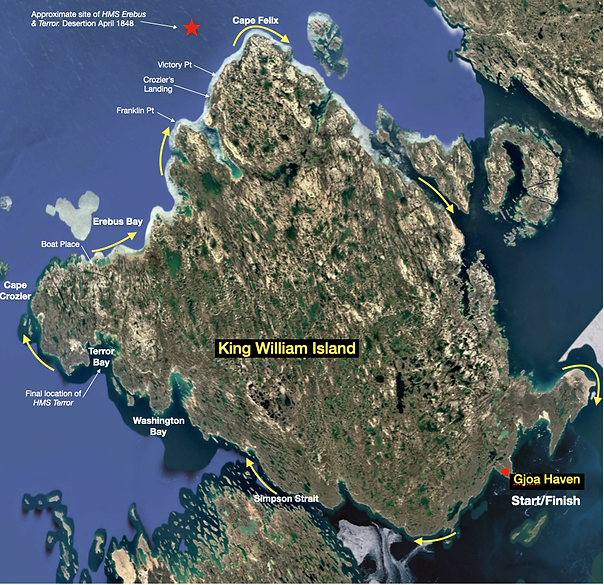
Our 4-person kayak team hope to complete a full survey of the coastline of King William Island. The team’s objective is to immerse themselves in the environment, history, and story of this important Canadian Arctic island. The journey, approximately 700 km in length, offers a rare blend of adventure and historical significance in a captivating arctic landscape.
Team leader, Kevin Vallely, led an expedition to King William Island in 2007 and undertook a survey of its southern coastline. Joined by respected Inuit oral historian Louis Kamookak, Vallely and team traveled the island’s south shore and were enlightened to the traditional Inuit accounts of the Franklin saga.
In July/August 2025 Vallely and team hope to return to the island to complete a full survey of its coastline. Key objectives include documenting the island's geography and wildlife, while showcasing its profound importance in the annals of polar exploration history from Franklin’s tragic saga to Amundsen’s success. By merging adventure with storytelling, the expedition aims to illuminate the story and the enduring legacy of exploration in this captivating polar landscape.
THE TEAM

Kevin Vallely
RCGS Fellow, Explorer's Club
As expedition leader, Kevin brings decades of polar experience and storytelling expertise that will anchor both the safety of the journey and the clarity of its narrative. He is a Fellow of the Royal Geographical Society, and a member of the Explorer’s Club.
Among Kevin’s many expeditions, he has rowed a boat across the stormy waters of the Northwest Passage to bring awareness to climate change. As part of a 3-person team, he broke the world record to the South Pole in 2009.

Julie Van de Valk
SAR team member and adventurer
Julie Van de Valk is a search and rescue volunteer with North Shore Rescue and an avid backcountry traveler. She is North Shore Rescue’s Training Officer, is a member of the team’s helicopter-based rescue (Class-D) team and leads the team’s mapping efforts. Recreationally, she enjoys traverses and long days out on skis, kayak, feet, or any other means, and loves her local coast range.
Her SAR expertise ensures preparedness in any emergency, while her passion for remote travel makes her an essential force on the team.

Nicky Hastings
Ultra-athlete and outdoor adventurer
Nicky has an extensive history in backcountry travel and has completed numerous multi-day kayak expeditions including a 1750km kayak journey down the length of the Mackenzie River in 2016. She was an elite level cross country skier and trail runner, winning numerous ultra-distance running races over the years. She works for the Geological Survey of Canada and has wilderness first-aid training.

Ken Stanick
Experienced explorer and CEO
Ken Stanick is a seasoned adventurer with a passion for pushing the limits of human endurance in some of the world’s most remote and unforgiving environments. Whether paragliding over the Coast range or racing a canoe down the mighty Yukon River, Ken brings a spirit of curiosity, courage, and grit to every journey.

THE HISTORY

The Franklin Expedition
The Franklin expedition, led by Sir John Franklin, departed England in 1845 with two ships, HMS Erebus and HMS Terror, in search of the Northwest Passage. King William Island played a crucial role in the expedition's tragic fate. In September 1846, both ships became trapped in ice off the northwest corner of King William Island, where they remained for over a year.
King William Island became the focal point of the expedition's demise. Franklin died on June 11, 1847, while the ships were still trapped. By April 1848, the surviving crew abandoned the vessels and attempted to march south across the island towards the Canadian mainland. The island's harsh environment and lack of resources contributed to the crew's suffering, with many perishing on its shores.
Archaeological findings on King William Island have provided valuable insights into the expedition's final days, including the discovery of human remains, artifacts, and the pivotal Victory Point Note. This note, found in a cairn on the island, remains the only known written record from the expedition, detailing their abandonment of the ships and Franklin's death. King William Island continues to be a site of ongoing research and discoveries, shedding light on one of the most infamous tragedies in Arctic exploration history.

Inuit History
Inuit have inhabited King William Island, known as Qikiqtaq in Inuktitut, for thousands of years. Archaeological evidence suggests that Paleoeskimo occupation of the region, including King William Island, dates back approximately 4,500 years. The rich oral traditions and legends associated with the island, such as the story of the ancient Tuniit people, further underscore the deep-rooted Inuit presence on King William Island.

Roald Amundsen
King William Island played a crucial role in Roald Amundsen's historic Northwest Passage expedition from 1903 to 1906. Amundsen anchored his ship, the Gjøa, at Gjoa Haven on the island's east coast, where he and his crew spent two winters conducting magnetic and meteorological observations. During this time, Amundsen learned invaluable Arctic survival skills from the local Netsilik Inuit, which would later prove essential in his successful South Pole expedition.

THE ROUTE

King William Island
-
The island, known as Qikiqtak in Inuktitut, has been an integral part of Inuit life and culture for thousands of years.
-
King William Island is more than a backdrop—it is a character in the story. From the chilling silence of Franklin’s final march to the lessons Amundsen learned from Inuit knowledge, this island has shaped the narrative of Arctic exploration for centuries.
-
Gjoa Haven, our start and finish, is named after Norwegian explorer Roald Amundsen's historic ship after he wintered there on his successful transit of the Northwest Passage.
-
An extreme tundra climate defines the island's environment.
-
Barren-ground caribou, muskox, snowy owl, peregrine falcons and polar bear inhabit the island.

EXPEDITION PARTNERS


